HEALTH/SCIENCE
Scientists Describe Extinct Arctic Rhino Unearthed In Canada

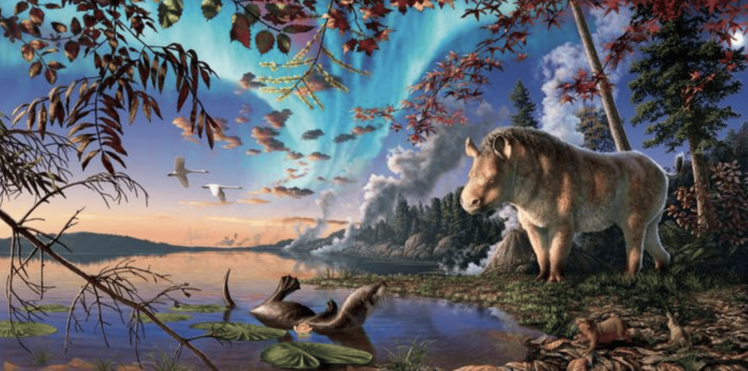
Scientists from the Canadian Museum of Nature have identified an extinct rhinoceros species that once roamed the Canadian High Arctic — the most northerly rhino ever discovered.
The fossil, unearthed from lakebed deposits in the Haughton Crater on Devon Island, Nunavut, dates back roughly 23 million years to the Early Miocene, revealing a species that thrived in a temperate Arctic long before it became the icy tundra of today. The newly described species, Epiaceratherium itjilik — meaning “frosty” in Inuktitut — has now been described in Nature Ecology and Evolution.
The nearly complete skeleton, about 75% intact, was first uncovered in 1986 by the late Mary Dawson of the Carnegie Museum of Natural History and later identified by Canadian Museum of Nature paleobiologists.
“Today there are only five species of rhinos in Africa and Asia, but in the past they were found in Europe and North America, with more than 50 species known from the fossil record,” said lead author Danielle Fraser, head of palaeobiology at the Canadian Museum of Nature (CMN). “The addition of this Arctic species to the rhino family tree now offers new insights to our understanding of their evolutionary history.”
The hornless Arctic rhino was roughly the size of a modern Indian rhinoceros and is thought to have migrated to North America from Europe, crossing a North Atlantic land bridge millions of years later than previously believed. The teams analysis of 57 other rhino species revealed that dispersals between Europe and North America may have continued into the Miocene epoch — about 23 to 5.6 million years ago — well after scientists thought the corridor had vanished.
“Whats remarkable about the Arctic rhino is that the fossil bones are in excellent condition,” said Marisa Gilbert, study co-author and senior research assistant at the museum. “They are three dimensionally preserved and have only been partially replaced by minerals. About 75% of the skeleton was discovered, which is incredibly complete for a fossil.”
The name itjilik was chosen in consultation with Inuit Elder Jarloo Kiguktak of Grise Fiord, honoring the rhinos Arctic origins. Fossils from the crater — a 14-mile wide (23 km) impact site that once held a lake surrounded by forest — continue to reveal a long-lost temperate ecosystem where ancient mammals thrived.
“Its always exciting and informative to describe a new species. But there is more that comes from the identification of Epiaceratherium itjilik, as our reconstructions of rhino evolution show that the North Atlantic played a much more important role in their evolution than previously thought,” Fraser said. “More broadly, this study reinforces that the Arctic continues to offer up new knowledge and discoveries that expand on our understanding of mammal diversification over time.”
The fossil now resides in the Canadian Museum of Natures national collections, representing a key link between prehistoric Arctic ecosystems and the global story of mammal evolution.