HEALTH/SCIENCE
Researchers Demonstrate ‘Walking’ Easter Island Statues With Massive Replica

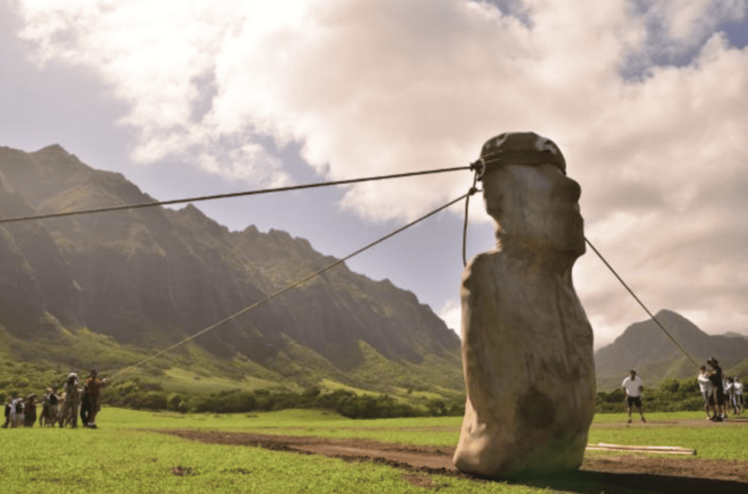
For centuries, the mystery of how the people of Rapa Nui, or Easter Island, moved their towering moai statues has baffled archaeologists, but new research led by Binghamton University confirms what island legend long suggested: the statues “walked.”
Using advanced 3D modeling, physics-based analysis, and full-scale experiments, Binghamton University Professor of Anthropology Carl Lipo and University of Arizona archaeologist Terry Hunt demonstrated that the colossal stone figures could be moved upright — not dragged or rolled — by rocking them side to side in a controlled, zig-zagging motion using ropes and teamwork.
“Once you get it moving, it isnt hard at all — people are pulling with one arm,” Lipo said. “It conserves energy, and it moves really quickly. The hard part is getting it rocking in the first place. The question is, if it’s really large, what would it take? Are the things that we saw experimentally consistent with what we would expect from a physics perspective?”
To test their theory, the team created high-resolution digital models of the moai, revealing key design features that made them inherently mobile: wide D-shaped bases and a slight forward lean. Those traits, Lipo explained, allowed the statues to pivot forward smoothly, maintaining balance as they “walked.”
The researchers then built a 4.35-ton replica to see if physics matched the legend. With just 18 people and a set of ropes, they moved the upright replica 100 meters, or about 328 feet, in 40 minutes — an impressive feat that outperformed past transport experiments.
“The physics makes sense,” Lipo said. “What we saw experimentally actually works. And as it gets bigger, it still works. All the attributes that we see about moving gigantic ones only get more and more consistent the bigger and bigger they get, because it becomes the only way you could move it.”
Their findings also shed new light on the islands ancient infrastructure. The concave roads, nearly 15 feet wide, that weave through Rapa Nui appear to have been designed specifically for this method of movement.
“Every time they’re moving a statue, it looks like they’re making a road. The road is part of moving the statue,” said Lipo. “We actually see them overlapping each other, and many parallel versions of them. What they are probably doing is clearing a path, moving it, clearing another, clearing it further, and moving it right in certain sequences. So they’re spending a lot of time on the road part.”
The study, published in the Journal of Archaeological Science, challenges earlier theories that the statues were transported horizontally on sleds or rollers.
“Find some evidence that shows it couldn’t be walking. Because nothing we’ve seen anywhere disproves that,” Lipo said. “In fact, everything we ever see and ever thought of keeps strengthening the argument.” Beyond solving an ancient mystery, Lipo said the work restores credit to the ingenuity of the Rapa Nui people.
“It shows that the Rapa Nui people were incredibly smart. They figured this out,” Lipo said. “Theyre doing it the way thats consistent with the resources they have. So it really gives honor to those people, saying, look at what they were able to achieve, and we have a lot to learn from them in these principles.”