HEALTH/SCIENCE
Recent Lunar Landslides Mostly Caused By ‘Moonquakes’, Study Suggests

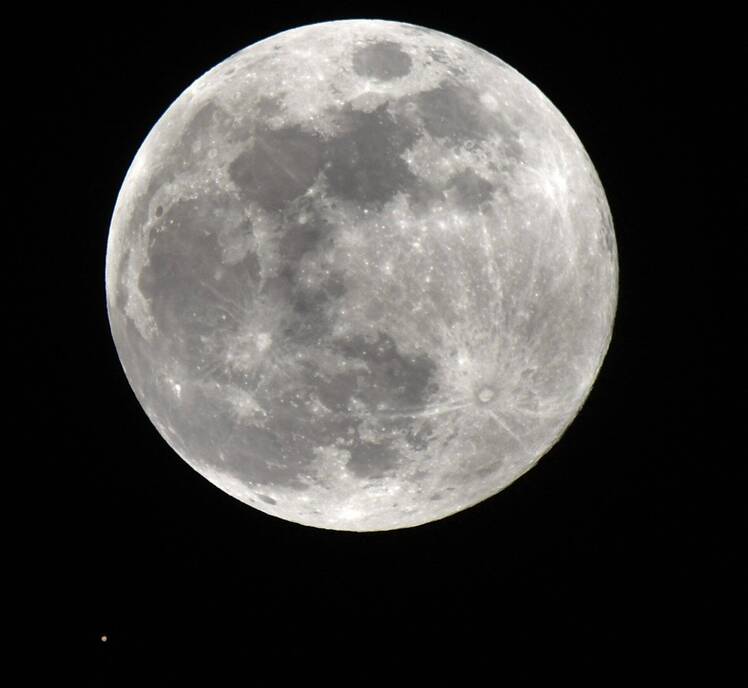
For decades, scientists assumed the moons frequent landslides were mainly caused by impacts from space rocks or the daily heating and cooling of its surface, but new research suggests that the real culprit is “moonquakes.”
A team led by Professor Zhiyong Xiao of China’s Sun Yat-sen University, with colleagues from Fuzhou University and Shanghai Normal University, analyzed multi-temporal images of the lunar surface taken between 2009 and 2024. Using 562 pairs of high-resolution images from 74 target sites on both the near and far sides of the moon, the team searched for short-term changes in unstable regions such as crater walls, fault ridges, and volcanic patches. Their results, set to be published in Oxford University Press journal National Science Review, revealed 41 new landslides, most of which could only be explained by seismic activity inside the moon.
“Worldwide lunar exploration is accelerating, with plans for permanent research stations and deep-space outposts,” said Xiao, the lead author of the study who also works with the Planetary Environmental and Astrobiological Research Laboratory at Sun Yat-sen University. “Understanding todays landslide activity and its drivers is essential for assessing geohazard risks to these future missions.”
The newly documented landslides are relatively small, measuring less than a kilometer, or about two-thirds of a mile, long, 328 feet wide, and a few feet thick, with volumes under roughly 130,000 cubic yards. They typically occur on slopes of 24 to 42 degrees — close to the natural angle at which loose lunar material becomes unstable. Unlike larger, ancient slides, these modern examples showed no signs of boulders breaking free from cliff faces.
Just 29% of the observed landslides (12 of 41) were associated with new impacts, even though more than 2,000 fresh craters have been recorded on the Moon in recent years. Some of the largest recent impacts, up to 246 feet wide, did not trigger landslides on nearby slopes. The finding suggests that impacts are not an efficient driver of slope failure.
By contrast, 71% of the slides had no connection to impacts or exposed rocks. Their distribution, clustering around the eastern Imbrium Basin, points instead to internal seismic activity. That basin, created 3.9 billion years ago by a massive asteroid strike, is already known as a hotspot for shallow moonquakes recorded by Apollo-era seismometers. The new study reinforces the idea that this area remains a seismically active zone.
By showing that current lunar landslides are largely triggered by moonquakes, the new study highlights the need to consider internal lunar activity in studies of its surface evolution, the authors say. The spatial pattern of recent landslides may even serve as a proxy for seismic activity, helping scientists map hidden quake zones without the need to deploy seismometers everywhere.
While the newly identified slides are small and localized, they highlight potential hazards for future missions. Facilities built near slopes in seismically active areas could be at risk. Researchers suggest prioritizing seismic and thermal studies in the eastern Imbrium Basin to better understand the moons interior dynamics.
“Our work reminds us the moon is not a static, dead world — besides abundant new impacts, landslide is active today,” Xiao said. “These insights bridge a gap between past lunar history and present-day processes, advancing both science and mission planning.”